- English
- French
- German
- Portuguese
- Spanish
- Russian
- Japanese
- Korean
- Arabic
- Greek
- German
- Turkish
- Italian
- Danish
- Romanian
- Indonesian
- Czech
- Afrikaans
- Swedish
- Polish
- Basque
- Catalan
- Esperanto
- Hindi
- Lao
- Albanian
- Amharic
- Armenian
- Azerbaijani
- Belarusian
- Bengali
- Bosnian
- Bulgarian
- Cebuano
- Chichewa
- Corsican
- Croatian
- Dutch
- Estonian
- Filipino
- Finnish
- Frisian
- Galician
- Georgian
- Gujarati
- Haitian
- Hausa
- Hawaiian
- Hebrew
- Hmong
- Hungarian
- Icelandic
- Igbo
- Javanese
- Kannada
- Kazakh
- Khmer
- Kurdish
- Kyrgyz
- Latin
- Latvian
- Lithuanian
- Luxembou..
- Macedonian
- Malagasy
- Malay
- Malayalam
- Maltese
- Maori
- Marathi
- Mongolian
- Burmese
- Nepali
- Norwegian
- Pashto
- Persian
- Punjabi
- Serbian
- Sesotho
- Sinhala
- Slovak
- Slovenian
- Somali
- Samoan
- Scots Gaelic
- Shona
- Sindhi
- Sundanese
- Swahili
- Tajik
- Tamil
- Telugu
- Thai
- Ukrainian
- Urdu
- Uzbek
- Vietnamese
- Welsh
- Xhosa
- Yiddish
- Yoruba
- Zulu
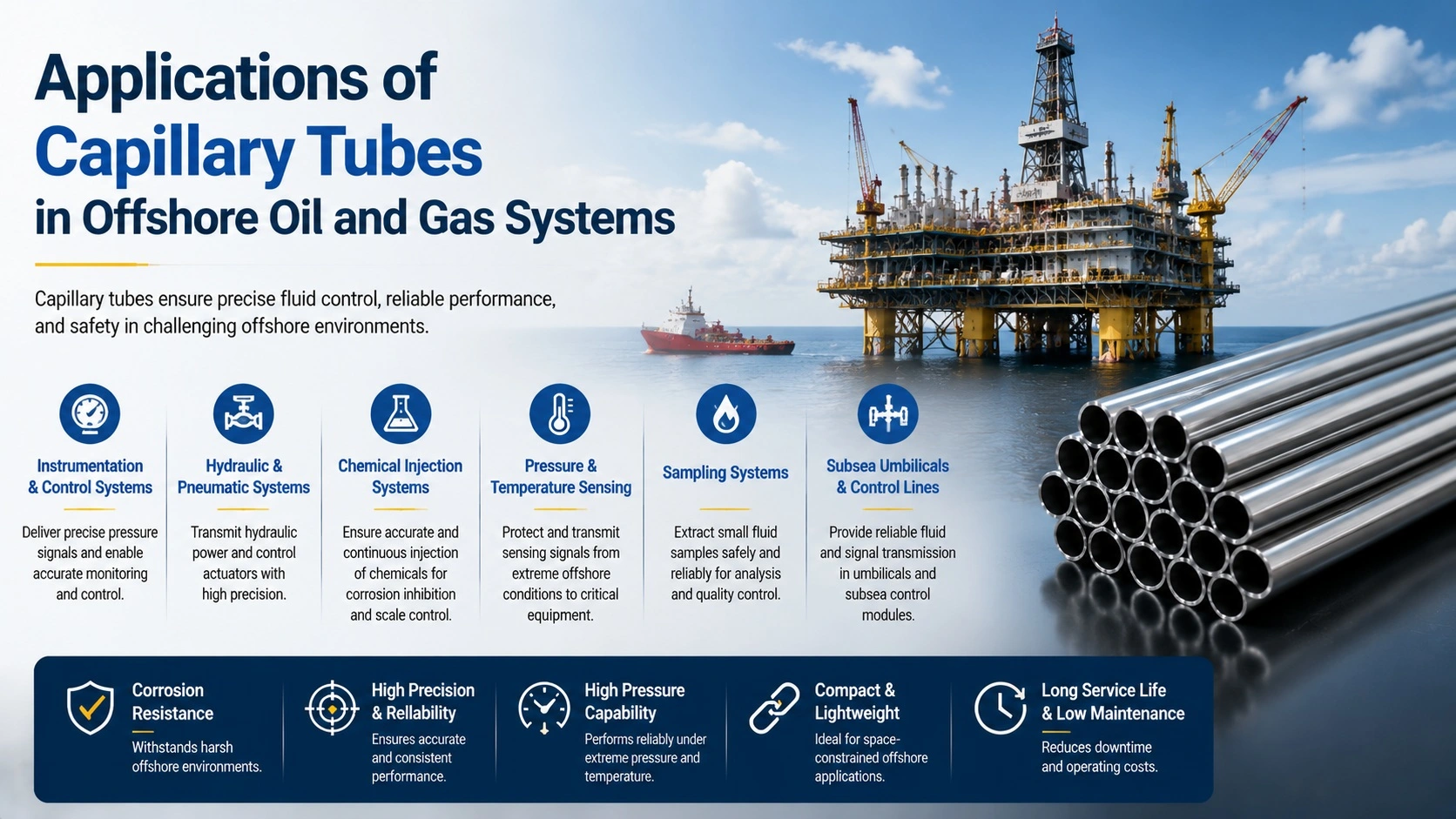
Applications of Capillary Tubes in Offshore Oil and Gas Systems
Offshore oil and gas systems operate in some of the most challenging industrial environments. Equipment must withstand seawater exposure, high pressure, temperature changes, and corrosive production fluids. These conditions require materials that can provide reliable performance over long operating periods.
A Nickel Alloy Capillary Tube is widely used in offshore applications because it combines corrosion resistance, mechanical strength, and precise dimensional control. These characteristics make it suitable for hydraulic control systems, chemical injection lines, subsea equipment, and offshore instrumentation.
Unlike standard tubing materials, nickel alloy capillary tubing is designed for applications where failure can lead to production interruptions, safety concerns, and expensive maintenance.
At TSM Technology, we manufacture nickel alloy tubing solutions for demanding industries, including offshore oil and gas, chemical processing, energy, and industrial equipment. Our products are designed to support customers requiring corrosion-resistant and precision-engineered tubing.
Why Offshore Oil and Gas Systems Require Specialized Tubing
Offshore equipment faces conditions that are more aggressive than many land-based applications.
Typical challenges include:
· Continuous seawater exposure
· High chloride concentration
· High operating pressure
· Temperature fluctuations
· Corrosive hydrocarbons
· Limited maintenance access
Subsea and offshore systems often operate for years without direct access for repair.
A tubing failure can result in:
· Production downtime
· Safety risks
· Expensive intervention work
· Environmental concerns
Material selection becomes a critical part of offshore engineering design.
What Is a Nickel Alloy Capillary Tube?
A Nickel Alloy Capillary Tube is a small-diameter precision tube manufactured from nickel-based alloys.
It is designed for systems that require accurate fluid or gas transmission.
Key characteristics include:
· Small outside diameter
· Controlled wall thickness
· High dimensional accuracy
· Excellent corrosion resistance
· Strong mechanical performance
Nickel alloy capillary tubes are commonly produced through precision manufacturing processes such as cold drawing and heat treatment.
These processes help achieve the dimensional control required for offshore applications.
Why Nickel Alloys Are Used in Offshore Applications
Offshore environments expose materials to multiple corrosion risks.
Nickel alloys are selected because they provide:
Strong Seawater Corrosion Resistance
Seawater contains chlorides that can damage many metals.
Nickel alloys maintain stable performance in marine environments.
01
Resistance to Corrosive Production Fluids
Oil and gas production fluids may contain:
· Hydrogen sulfide
· Carbon dioxide
· Chlorides
· Organic acids
Certain nickel alloys provide excellent resistance in these conditions.
02
High Temperature Performance
Offshore systems may operate under elevated temperatures.
Nickel alloys maintain strength and corrosion resistance in demanding thermal conditions.
03
Long-Term Reliability
Offshore equipment requires materials that reduce maintenance requirements.
Durable tubing helps improve operational reliability.
04
Main Offshore Applications of Nickel Alloy Capillary Tubes
Nickel alloy capillary tubing supports several important offshore systems.
Hydraulic Control Lines
Hydraulic control systems operate valves and subsea equipment.
These systems require tubing that can withstand:
· High pressure
· Mechanical stress
· Marine exposure
Nickel alloy capillary tubes are used in hydraulic control applications because they provide:
· Pressure resistance
· Corrosion protection
· Dimensional stability
Reliable hydraulic tubing helps ensure accurate control of offshore equipment.
Subsea Control Systems
Subsea production systems operate below the ocean surface under difficult conditions.
Control systems may include:
· Subsea valves
· Wellhead equipment
· Safety systems
· Remote operating systems
Capillary tubing supports hydraulic and chemical control functions in these systems.
The tubing must maintain performance despite:
· High external pressure
· Seawater contact
· Long service periods
Nickel alloys provide the corrosion resistance required for these applications.
Chemical Injection Systems
Chemical injection plays an important role in offshore production.
Operators inject chemicals to control:
· Corrosion
· Scale formation
· Hydrate formation
Injection lines require tubing that can handle both the injected chemicals and the offshore environment.
Nickel alloy capillary tubing provides:
· Chemical resistance
· Stable flow performance
· Long service life
This helps maintain production efficiency.
Offshore Instrumentation Systems
Accurate monitoring is essential for offshore operations.
Instrumentation systems measure:
· Pressure
· Temperature
· Flow conditions
· Process performance
Capillary tubing connects sensors and monitoring equipment.
The tubing must provide:
· Accurate dimensions
· Clean internal surfaces
· Reliable corrosion resistance
Nickel alloy tubing helps maintain measurement accuracy in offshore environments.
Downhole Monitoring and Control Applications
Modern oil and gas operations rely on advanced monitoring technologies.
Capillary tubes may support:
· Pressure monitoring systems
· Hydraulic control systems
· Chemical delivery systems
These applications require tubing that can handle underground and offshore conditions.
Important requirements include:
· High strength
· Corrosion resistance
· Stable mechanical properties
Nickel alloys meet many of these demanding requirements.
Common Nickel Alloy Grades for Offshore Capillary Tubing
Different offshore environments require different nickel alloy materials.
Inconel 625
Inconel 625 is widely recognized for its:
· High corrosion resistance
· Good strength
· Resistance to seawater and chloride environments
It is commonly used in offshore and marine applications.
01
Hastelloy C-276
Hastelloy C-276 provides excellent resistance to aggressive chemical environments.
It is suitable for systems exposed to:
· Strong acids
· Chloride solutions
· Chemical processing conditions
02
Monel 400
Monel 400 performs well in marine environments.
It is commonly considered for applications involving:
· Seawater
· Salt solutions
· Marine equipment
03
Incoloy 825
Incoloy 825 provides good resistance to:
· Acid environments
· Chlorides
· Stress corrosion cracking
The correct alloy depends on the operating conditions.
04
Manufacturing Process of Offshore Nickel Alloy Capillary Tubes
Offshore applications require consistent product quality.
Nickel alloy capillary tubes are typically produced through controlled manufacturing steps:
· Tube forming
· Cold drawing
· Heat treatment
· Straightening
· Surface finishing
· Inspection
Cold Drawing
Cold drawing improves:
· Dimensional accuracy
· Surface finish
· Mechanical strength
This process is important for producing precision tubing.
Heat Treatment
Heat treatment helps:
· Reduce internal stress
· Restore ductility
· Stabilize material properties
The combination of cold drawing and heat treatment helps produce reliable offshore tubing.
Quality Requirements for Offshore Tubing
Offshore projects require strict quality control.
Important inspections include:
Chemical Composition Testing
Confirms the alloy meets required specifications.
Mechanical Testing
Evaluates:
· Tensile strength
· Yield strength
· Elongation
· Hardness
Dimensional Inspection
Checks:
· Outside diameter
· Inside diameter
· Wall thickness
· Length
Non-Destructive Testing
Common methods include:
· Eddy current testing
· Ultrasonic testing
· Hydrostatic testing
These inspections help verify product reliability.
Nickel Alloy Capillary Tube Standards for Offshore Projects
Offshore customers often require tubing manufactured according to recognized standards.
Common specifications include:
· ASTM B163
· ASTM B444
· ASTM B622
· ASTM B626
These standards define requirements related to:
· Material composition
· Mechanical properties
· Testing procedures
· Manufacturing quality
Project specifications should always be confirmed before production.
Advantages of Nickel Alloy Capillary Tubes Compared With Conventional Materials
Offshore systems often compare nickel alloys with stainless steel or other materials.
|
Feature |
Stainless Steel Tubing |
Nickel Alloy Capillary Tube |
|
Seawater Resistance |
Good |
Excellent |
|
Chloride Resistance |
Moderate to Good |
Excellent |
|
High Temperature Performance |
Good |
Excellent |
|
Chemical Resistance |
Limited in severe conditions |
Strong |
|
Offshore Critical Applications |
Limited |
Widely Used |
The best material depends on the specific environment, pressure, and chemical exposure.
How to Select a Nickel Alloy Capillary Tube Supplier
Offshore projects require suppliers with strong technical capability.
Important factors include:
Manufacturing Experience
Suppliers should understand:
· Nickel alloy processing
· Precision tube production
· Offshore application requirements
Quality Documentation
Customers often require:
· Material certificates
· Inspection reports
· Traceability records
Customization Capability
Offshore systems may require customized:
· Alloy grades
· Tube dimensions
· Wall thickness
· Length
Technical Support
A knowledgeable supplier can help select suitable materials based on operating conditions.
Why Nickel Alloy Capillary Tubes Remain Important in Offshore Engineering
Offshore oil and gas systems continue to demand tubing solutions that provide:
· Corrosion resistance
· High strength
· Precision performance
· Long service life
A Nickel Alloy Capillary Tube supports critical offshore applications by providing reliable performance in harsh marine environments.
From hydraulic control lines to chemical injection systems, precision nickel alloy tubing helps improve offshore equipment reliability.
At TSM Technology we provide nickel alloy tubing solutions for industrial customers worldwide.
For technical specifications, quotations, or customized offshore tubing requirements, contact us at info@tsmnialloy.com.
Frequently Asked Questions
Why are nickel alloy capillary tubes used offshore?
They provide strong corrosion resistance, pressure capability, and reliable performance in marine environments.
What are common offshore applications for capillary tubing?
Applications include hydraulic control lines, chemical injection systems, subsea equipment, and instrumentation systems.
Which nickel alloy is suitable for offshore oil and gas?
The suitable alloy depends on temperature, pressure, and corrosion conditions. Inconel, Hastelloy, Monel, and Incoloy grades are commonly selected.
Are nickel alloy capillary tubes suitable for subsea systems?
Yes. Their corrosion resistance and mechanical stability make them suitable for many subsea control applications.
Can offshore capillary tubes be customized?
Yes. Manufacturers can provide customized dimensions, materials, and inspection requirements.
References
1. ASTM International. ASTM B163 Standard Specification for Seamless Nickel and Nickel Alloy Condenser and Heat-Exchanger Tubes.
2. ASTM International. ASTM B444 Standard Specification for Nickel-Chromium-Molybdenum-Columbium Alloy Tubes.
3. ASTM International. ASTM B622 Standard Specification for Seamless Nickel and Nickel-Cobalt Alloy Pipe and Tube.
4. ASM International. Properties and Selection: Nonferrous Alloys and Special-Purpose Materials.
5. Davis, Joseph R. Nickel, Cobalt, and Their Alloys. ASM International.
6. National Association of Corrosion Engineers (NACE). Corrosion Control in the Oil and Gas Industry.
Learn about our latest products and discounts through SMS or email