- English
- French
- German
- Portuguese
- Spanish
- Russian
- Japanese
- Korean
- Arabic
- Greek
- German
- Turkish
- Italian
- Danish
- Romanian
- Indonesian
- Czech
- Afrikaans
- Swedish
- Polish
- Basque
- Catalan
- Esperanto
- Hindi
- Lao
- Albanian
- Amharic
- Armenian
- Azerbaijani
- Belarusian
- Bengali
- Bosnian
- Bulgarian
- Cebuano
- Chichewa
- Corsican
- Croatian
- Dutch
- Estonian
- Filipino
- Finnish
- Frisian
- Galician
- Georgian
- Gujarati
- Haitian
- Hausa
- Hawaiian
- Hebrew
- Hmong
- Hungarian
- Icelandic
- Igbo
- Javanese
- Kannada
- Kazakh
- Khmer
- Kurdish
- Kyrgyz
- Latin
- Latvian
- Lithuanian
- Luxembou..
- Macedonian
- Malagasy
- Malay
- Malayalam
- Maltese
- Maori
- Marathi
- Mongolian
- Burmese
- Nepali
- Norwegian
- Pashto
- Persian
- Punjabi
- Serbian
- Sesotho
- Sinhala
- Slovak
- Slovenian
- Somali
- Samoan
- Scots Gaelic
- Shona
- Sindhi
- Sundanese
- Swahili
- Tajik
- Tamil
- Telugu
- Thai
- Ukrainian
- Urdu
- Uzbek
- Vietnamese
- Welsh
- Xhosa
- Yiddish
- Yoruba
- Zulu
Nickel Alloy Capillary Tubes in Chemical Processing Plants
Chemical processing plants operate with aggressive acids, chlorides, solvents, and high-temperature fluids. These conditions place strict demands on material selection. A Nickel Alloy Capillary Tube provides the corrosion resistance, dimensional accuracy, and reliability needed for many chemical processing applications.
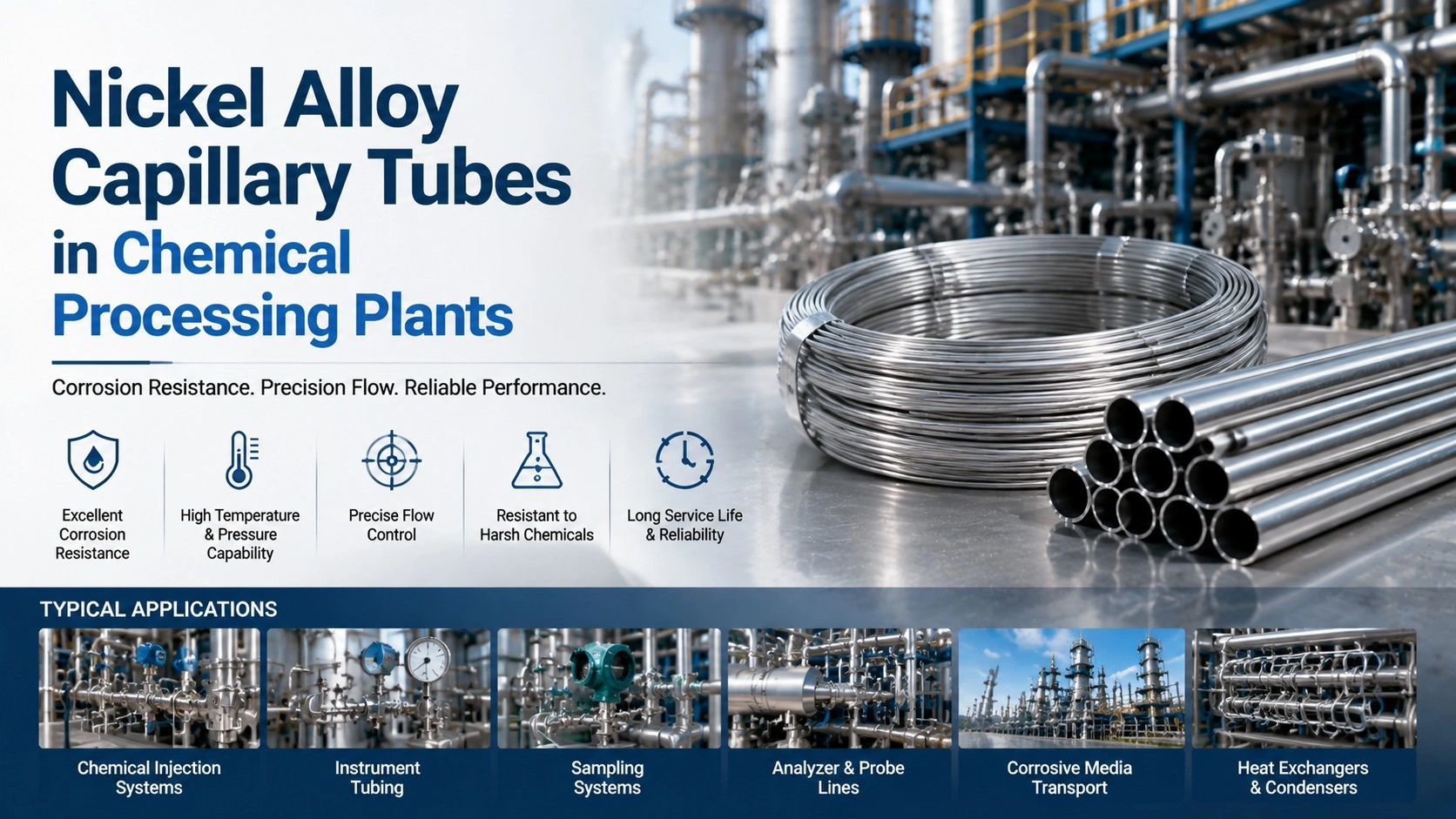
Unlike standard tubing materials, nickel alloys maintain stable performance in environments where corrosion can quickly damage conventional metals. Their resistance to oxidation, chemical attack, and high temperatures makes them suitable for precision systems such as sampling lines, instrumentation systems, analyzer equipment, and chemical injection systems.
At TSM Technology, we manufacture nickel alloy tubes designed for demanding industrial applications. Our products support industries that require reliable performance in corrosive environments, including chemical processing, oil and gas, energy, and aerospace.
This article explains why nickel alloy capillary tubes are widely used in chemical plants, how they perform, and what factors engineers should consider when selecting tubing.
per ab Weston et al elaboratum est,
Why Chemical Processing Plants Need Advanced Tubing Materials
Chemical plants handle materials that can quickly attack common metals.
Operating environments may include:
· Strong acids
· Chloride-containing solutions
· High-temperature chemicals
· Pressurized process fluids
· Oxidizing and reducing media
Common materials such as carbon steel and some stainless steels may experience:
· Pitting corrosion
· Crevice corrosion
· Stress corrosion cracking
· General corrosion
When tubing fails, the results can include:
· Process interruption
· Chemical leakage
· Safety risks
· Increased maintenance costs
For this reason, engineers often select nickel alloys for critical chemical processing systems.
What Is a Nickel Alloy Capillary Tube?
A Nickel Alloy Capillary Tube is a precision tube manufactured from nickel-based alloys with a small outside diameter and controlled wall thickness.
Compared with standard industrial tubes, capillary tubing focuses on:
· Precise dimensions
· Smooth internal surfaces
· Reliable pressure performance
· Corrosion resistance
· Accurate fluid control
These characteristics make capillary tubes suitable for applications where small amounts of liquid or gas must move through a controlled pathway.
In chemical plants, even small changes in tube dimensions can affect:
· Flow accuracy
· Sampling results
· Instrument response
· System stability
Why Nickel Alloys Are Suitable for Chemical Processing Applications
Nickel alloys are selected because they combine corrosion resistance with mechanical strength.
Their main advantages include:
Resistance to Aggressive Chemicals
Many nickel alloys perform well in environments containing:
· Hydrochloric acid
· Sulfuric acid
· Organic acids
· Chloride solutions
· Seawater-related chemicals
Different alloy grades provide different levels of protection depending on the chemical environment.
High Temperature Capability
Chemical processes often operate at elevated temperatures.
Nickel alloys maintain strength and corrosion resistance under heat exposure.
Excellent Mechanical Stability
Nickel alloy capillary tubes can maintain dimensional accuracy under pressure and temperature changes.
Long Service Life
Corrosion-resistant materials help reduce replacement frequency and maintenance requirements.
Common Nickel Alloy Grades Used in Chemical Plants
Different chemical environments require different alloy solutions.
Hastelloy Alloys
Hastelloy grades are commonly selected for severe chemical environments.
They provide strong resistance against:
· Acids
· Chlorides
· Oxidizing chemicals
Common applications include chemical reactors, process equipment, and analyzer systems.
Inconel Alloys
Inconel grades are widely used where both corrosion resistance and high-temperature strength are required.
Applications include:
· Heat treatment systems
· High-temperature chemical equipment
· Process control systems
Incoloy Alloys
Incoloy alloys provide good resistance in many chemical and energy applications.
They are often used in:
· Heat exchangers
· Chemical processing equipment
· High-temperature environments
Monel Alloys
Monel alloys provide excellent resistance to seawater and certain chemical solutions.
They are suitable for:
· Marine chemical systems
· Alkali environments
· Process equipment
Applications of Nickel Alloy Capillary Tubes in Chemical Processing Plants
Nickel alloy capillary tubes are used in many parts of chemical production systems.
Process Instrumentation Systems
Instrumentation plays an important role in monitoring chemical processes.
Capillary tubing is used for:
· Pressure measurement systems
· Analytical instruments
· Control equipment
· Sensor connections
Accurate dimensions help maintain stable measurement performance.
Chemical Sampling Systems
Chemical plants often require continuous sampling of process fluids.
Sampling systems need tubing that can resist:
· Chemical attack
· Contamination
· Temperature changes
Nickel alloy capillary tubes provide reliable performance in these environments.
Chemical Injection Systems
Chemical injection equipment requires precise fluid delivery.
Applications include:
· Corrosion inhibitor injection
· Catalyst systems
· Process chemical dosing
The tubing must maintain accurate flow while resisting chemical exposure.
Heat Exchanger Instrumentation
Heat exchangers in chemical plants often operate under challenging conditions.
Capillary tubing supports:
· Temperature monitoring
· Pressure measurement
· Control systems
Nickel alloys help maintain reliability near heat and corrosive fluids.
Process Analyzer Systems
Modern chemical plants use analyzers to monitor production quality.
These systems require:
· Clean internal surfaces
· Stable material performance
· Precise dimensions
Nickel alloy tubing helps maintain accurate analysis results.
Seamless Nickel Alloy Capillary Tubes for Chemical Applications
Many chemical processing applications prefer seamless tubing.
A seamless nickel alloy capillary tube has no welded seam, which provides advantages such as:
· Higher pressure reliability
· Uniform structure
· Better resistance in critical applications
Manufacturing seamless tubing usually involves:
· Tube forming
· Cold drawing
· Heat treatment
· Precision inspection
Cold drawing improves dimensional accuracy, while heat treatment restores material properties after processing.
How Manufacturing Quality Affects Chemical Plant Performance
Chemical plants require tubing with consistent quality.
Important manufacturing controls include:
Dimensional Accuracy
Precise control of:
· Outside diameter
· Inside diameter
· Wall thickness
helps ensure proper installation and stable operation.
Surface Quality
Smooth internal surfaces reduce contamination risks and support clean process conditions.
Material Verification
Chemical plants often require:
· Chemical composition testing
· Mechanical testing
· Material certificates
Non-Destructive Testing
Common inspections include:
· Eddy current testing
· Ultrasonic testing
· Hydrostatic testing
These processes help identify potential defects before shipment.
Selecting the Right Nickel Alloy Capillary Tube for Chemical Plants
Choosing the correct tube requires understanding the operating environment.
Important factors include:
Chemical Media
Identify the chemicals contacting the tube.
Different alloys provide different corrosion resistance.
Temperature Conditions
High-temperature processes require alloys that maintain strength under heat.
Pressure Requirements
Higher pressure systems may require specific wall thickness designs.
Tube Dimensions
Engineers should confirm:
· Outside diameter
· Inside diameter
· Wall thickness
· Length requirements
Industry Standards
Projects may require compliance with ASTM specifications.
Selecting the correct combination of alloy and dimensions improves system reliability.
Advantages of Using Nickel Alloy Capillary Tubes Over Stainless Steel
Stainless steel works well in many applications, but chemical environments can exceed its limits.
Nickel alloy capillary tubes offer advantages in more demanding conditions:
|
Feature |
Stainless Steel Tubes |
Nickel Alloy Capillary Tubes |
|
Corrosion Resistance |
Good |
Excellent |
|
Acid Resistance |
Limited in some conditions |
Strong |
|
High Temperature Performance |
Moderate |
Excellent |
|
Chloride Resistance |
Variable |
High |
|
Critical Chemical Applications |
Limited |
Suitable |
The correct material depends on the specific chemical environment.
What Buyers Should Look for in a Nickel Alloy Tube Supplier
Selecting a reliable supplier helps ensure long-term equipment performance.
Important supplier capabilities include:
Manufacturing Experience
A supplier should understand:
· Nickel alloy processing
· Precision tube production
· Heat treatment requirements
Quality Documentation
Industrial buyers often require:
· Material Test Certificates
· Inspection reports
· Traceability documents
Custom Production Capability
Projects may require customized:
· Alloy grades
· Tube sizes
· Wall thickness
· Surface conditions
Global Supply Experience
International projects require reliable packaging, documentation, and delivery support.
Why Nickel Alloy Capillary Tubes Remain Important in Chemical Processing
Chemical processing plants continue to demand materials that provide:
· Reliable corrosion resistance
· Stable performance
· Accurate fluid control
· Long operating life
A Nickel Alloy Capillary Tube meets these requirements through advanced alloy design and precision manufacturing.
From chemical sampling systems to instrumentation equipment, nickel alloy tubing supports safer and more efficient plant operations.
Frequently Asked Questions
Why are nickel alloy capillary tubes used in chemical plants?
They provide excellent corrosion resistance, dimensional accuracy, and reliable performance in aggressive chemical environments.
Which nickel alloy is suitable for chemical processing?
The best alloy depends on the chemical media, temperature, and operating conditions. Hastelloy, Inconel, Incoloy, and Monel alloys are commonly selected.
Are nickel alloy capillary tubes suitable for high-temperature applications?
Yes. Many nickel alloys maintain mechanical strength and corrosion resistance at elevated temperatures.
What industries use nickel alloy capillary tubing?
Applications include chemical processing, oil and gas, aerospace, power generation, and instrumentation industries.
Can nickel alloy capillary tubes be customized?
Yes. Manufacturers can provide customized dimensions, alloy grades, and surface requirements.
References
1. ASTM International. ASTM B163 Standard Specification for Seamless Nickel and Nickel Alloy Condenser and Heat-Exchanger Tubes.
2. ASTM International. ASTM B622 Standard Specification for Seamless Nickel and Nickel-Cobalt Alloy Pipe and Tube.
3. ASTM International. ASTM B626 Standard Specification for Welded Nickel and Nickel-Cobalt Alloy Tube.
4. Davis, Joseph R. Nickel, Cobalt, and Their Alloys. ASM International.
5. ASM International. Properties and Selection: Nonferrous Alloys and Special-Purpose Materials.
6. Special Metals Corporation. High Performance Nickel Alloys Technical Data and Applications.
Contact us
At TSM Technology, we provide precision nickel alloy tubing solutions for industrial customers worldwide.
If you need technical information, material recommendations, or customized nickel alloy capillary tubes, contact us at info@tsmnialloy.com.
Learn about our latest products and discounts through SMS or email