- English
- French
- German
- Portuguese
- Spanish
- Russian
- Japanese
- Korean
- Arabic
- Greek
- German
- Turkish
- Italian
- Danish
- Romanian
- Indonesian
- Czech
- Afrikaans
- Swedish
- Polish
- Basque
- Catalan
- Esperanto
- Hindi
- Lao
- Albanian
- Amharic
- Armenian
- Azerbaijani
- Belarusian
- Bengali
- Bosnian
- Bulgarian
- Cebuano
- Chichewa
- Corsican
- Croatian
- Dutch
- Estonian
- Filipino
- Finnish
- Frisian
- Galician
- Georgian
- Gujarati
- Haitian
- Hausa
- Hawaiian
- Hebrew
- Hmong
- Hungarian
- Icelandic
- Igbo
- Javanese
- Kannada
- Kazakh
- Khmer
- Kurdish
- Kyrgyz
- Latin
- Latvian
- Lithuanian
- Luxembou..
- Macedonian
- Malagasy
- Malay
- Malayalam
- Maltese
- Maori
- Marathi
- Mongolian
- Burmese
- Nepali
- Norwegian
- Pashto
- Persian
- Punjabi
- Serbian
- Sesotho
- Sinhala
- Slovak
- Slovenian
- Somali
- Samoan
- Scots Gaelic
- Shona
- Sindhi
- Sundanese
- Swahili
- Tajik
- Tamil
- Telugu
- Thai
- Ukrainian
- Urdu
- Uzbek
- Vietnamese
- Welsh
- Xhosa
- Yiddish
- Yoruba
- Zulu
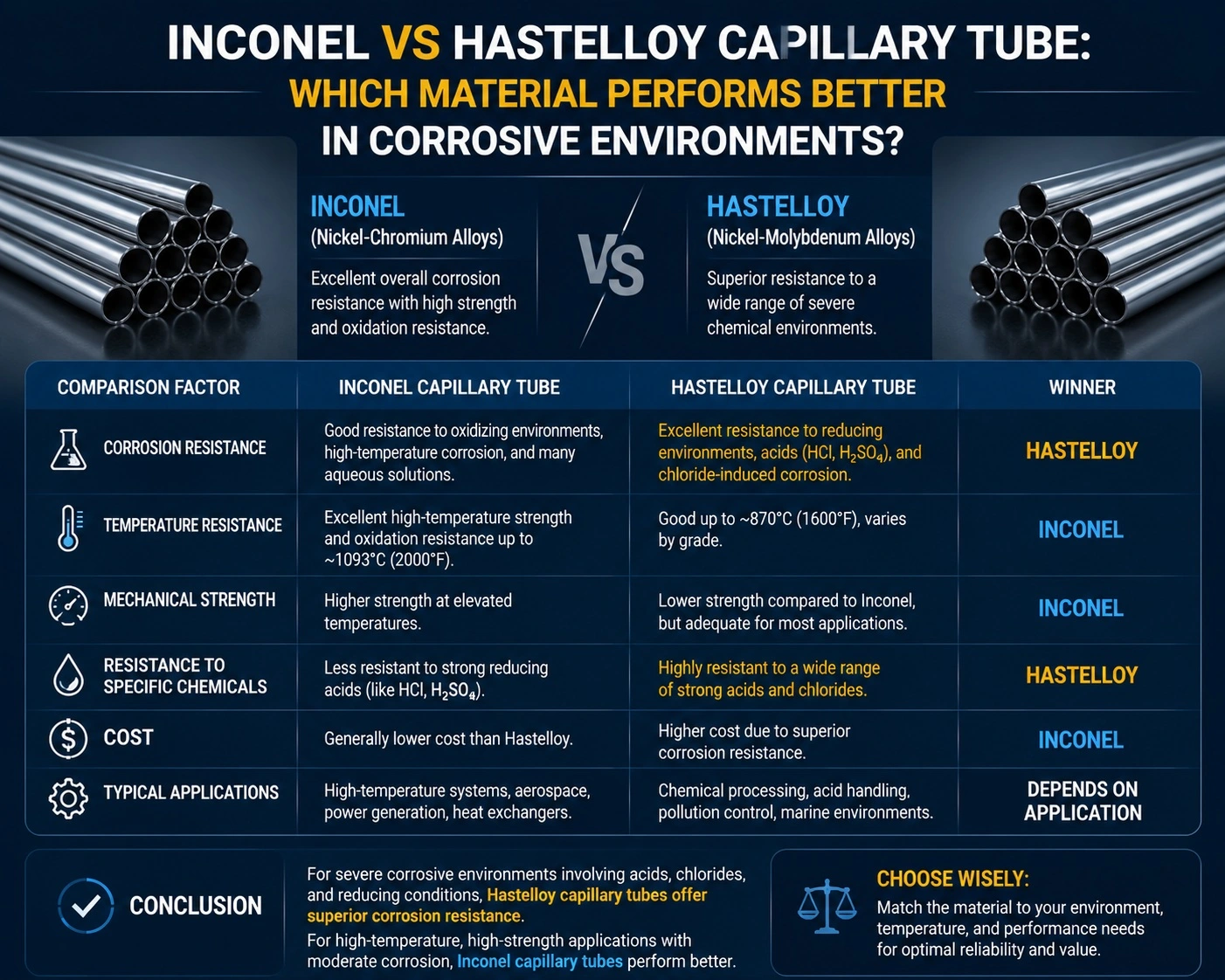
Inconel vs Hastelloy Capillary Tube: Which Material Performs Better in Corrosive Environments?
Choosing the right material for a Nickel Alloy Capillary Tube is critical when the tubing must operate in corrosive environments. Inconel and Hastelloy are two widely used nickel-based alloys known for their excellent corrosion resistance, mechanical strength, and reliability in demanding industries.
Both materials perform well, but they are designed for different challenges. Inconel is often selected for applications requiring high-temperature strength, oxidation resistance, and general corrosion protection. Hastelloy is commonly chosen when equipment faces severe chemical exposure, especially aggressive acids and chloride-containing environments.
ABOUT US
For engineers and purchasing teams, understanding the differences between Inconel capillary tubes and Hastelloy capillary tubes helps avoid material selection problems and improves long-term equipment reliability.
At TSM Technology, we manufacture nickel alloy tubing solutions for chemical processing, aerospace, offshore, energy, and industrial applications. Our precision nickel alloy tubes are produced for customers requiring corrosion resistance, accurate dimensions, and dependable performance.
Why Material Selection Matters for Corrosive Applications
Corrosion is one of the main causes of industrial equipment failure.
In chemical and energy industries, tubing may contact:
· Hydrochloric acid
· Sulfuric acid
· Chloride solutions
· Seawater
· High-temperature gases
· Process chemicals
A material that performs well in one environment may not be suitable for another.
Poor material selection can lead to:
· Leakage
· Reduced equipment life
· Production downtime
· Higher maintenance costs
When selecting a Nickel Alloy Capillary Tube, engineers usually evaluate:
· Chemical resistance
· Temperature capability
· Pressure requirements
· Mechanical properties
· Service environment
What Are Inconel and Hastelloy Capillary Tubes?
Both Inconel and Hastelloy belong to the nickel alloy family.
They are designed to provide better performance than conventional stainless steels in demanding environments.
Inconel Capillary Tube
Inconel alloys are nickel-chromium-based materials known for:
· High-temperature strength
· Oxidation resistance
· Good corrosion resistance
· Excellent mechanical stability
Common grades include:
· Inconel 600
· Inconel 625
· Inconel 718
Inconel capillary tubes are widely used in aerospace, chemical processing, power generation, and marine applications.
Hastelloy Capillary Tube
Hastelloy alloys are nickel-molybdenum-chromium alloys developed for severe corrosion conditions.
They are known for:
· Excellent resistance to aggressive chemicals
· Strong chloride resistance
· Resistance to localized corrosion
Common grades include:
· Hastelloy C-276
· Hastelloy C-22
Hastelloy capillary tubes are often used in chemical processing equipment and highly corrosive environments.
Inconel vs Hastelloy: Key Performance Comparison
The best choice depends on the actual operating conditions.
|
Property |
Inconel Capillary Tube |
Hastelloy Capillary Tube |
|
Main Alloy Elements |
Nickel-Chromium |
Nickel-Molybdenum-Chromium |
|
High Temperature Strength |
Excellent |
Very Good |
|
Oxidation Resistance |
Excellent |
Good |
|
Acid Resistance |
Good to Excellent |
Excellent |
|
Chloride Resistance |
Good |
Excellent |
|
Chemical Processing Applications |
Widely Used |
Preferred for Severe Chemicals |
|
Aerospace Applications |
Common |
Less Common |
Both materials provide reliable performance, but their strengths are different.
Corrosion Resistance: Which Material Performs Better?
Corrosion resistance is often the deciding factor when choosing between Inconel and Hastelloy.
Inconel Performance in Corrosive Environments
Inconel alloys provide excellent resistance against many common industrial conditions.
They perform well in:
· Oxidizing environments
· High-temperature applications
· Steam systems
· Marine atmospheres
Inconel 625, for example, provides strong resistance against many corrosive environments due to its chromium and molybdenum content.
Hastelloy Performance in Corrosive Environments
Hastelloy alloys are designed for more aggressive chemical conditions.
They are commonly selected for environments containing:
· Strong acids
· Chlorides
· Chemical mixtures
· Reducing and oxidizing conditions
Hastelloy C-276 is widely recognized for resistance against pitting, crevice corrosion, and stress corrosion cracking.
For severe chemical processing environments, Hastelloy often provides a stronger corrosion solution.
Temperature Performance Comparison
Temperature capability is another important consideration.
Inconel for High Temperature Applications
Inconel alloys are widely used where high temperatures and mechanical strength are required.
Applications include:
· Aerospace systems
· Heat treatment equipment
· Power generation components
Their strength retention at elevated temperatures makes them suitable for thermal environments.
Hastelloy for High Temperature Chemical Service
Hastelloy alloys also perform well at elevated temperatures, especially when corrosion resistance is the main concern.
They are commonly used in:
· Chemical reactors
· Acid processing systems
· High-temperature chemical equipment
When both heat and aggressive chemicals exist, Hastelloy may provide advantages.
Applications of Inconel Capillary Tubes
Inconel capillary tubes are commonly used in industries requiring strength and temperature resistance.
Typical applications include:
Aerospace Hydraulic Systems
Inconel tubing supports:
· Hydraulic control systems
· Fuel systems
· Engine-related applications
Heat Exchangers
Inconel provides resistance to:
· Heat
· Oxidation
· Thermal cycling
Power Generation
Applications include:
· Steam systems
· High-temperature equipment
· Process monitoring systems
Applications of Hastelloy Capillary Tubes
Hastelloy capillary tubes are commonly selected for severe corrosion environments.
Typical applications include:
Chemical Processing Plants
Used in:
· Sampling systems
· Chemical injection lines
· Process instrumentation
Pharmaceutical and Specialty Chemical Production
Used where contamination control and corrosion resistance are important.
Pollution Control Equipment
Used in systems handling aggressive chemical gases and liquids.
Manufacturing Requirements for Nickel Alloy Capillary Tubes
Regardless of alloy selection, manufacturing quality directly affects performance.
A reliable Nickel Alloy Capillary Tube requires controlled production processes.
Typical manufacturing steps include:
· Material preparation
· Tube forming
· Cold drawing
· Heat treatment
· Surface finishing
· Dimensional inspection
Cold Drawing
Cold drawing improves:
· Tube size accuracy
· Surface quality
· Mechanical properties
It is essential for producing precision capillary tubing.
Heat Treatment
Heat treatment helps:
· Reduce internal stress
· Restore ductility
· Stabilize material performance
These processes help ensure reliable operation in demanding environments.
How to Choose Between Inconel and Hastelloy Capillary Tubes
There is no single material that is best for every application.
Consider the following factors:
Chemical Exposure
Choose Hastelloy when the system involves:
· Strong acids
· Chlorides
· Complex chemical mixtures
Choose Inconel when the system requires:
· Oxidation resistance
· High-temperature performance
· General corrosion resistance
Operating Temperature
For extreme heat conditions, Inconel is often preferred.
Corrosion Severity
For highly aggressive chemical environments, Hastelloy is usually a stronger option.
Industry Requirements
Different industries may have specific material standards and qualification requirements.
How TSM Nialloy Supports Nickel Alloy Tube Applications
Selecting the correct alloy is only part of the solution. Manufacturing quality also affects service performance.
At TSM Nialloy, we provide nickel alloy tubing solutions for demanding industrial applications.
Our capabilities include:
· Nickel alloy capillary tubes
· Seamless nickel alloy tubes
· Precision tubing production
· Material traceability
· Quality inspection
We support customers who need reliable tubing for:
· Chemical processing
· Aerospace
· Offshore oil and gas
· Energy systems
Our technical team can help customers select suitable nickel alloy materials based on application conditions.
For technical specifications, quotations, or customized requirements, contact us at info@tsmnialloy.com.
Frequently Asked Questions
Is Hastelloy better than Inconel for corrosion resistance?
It depends on the environment. Hastelloy generally performs better in severe chemical conditions, while Inconel provides excellent corrosion resistance with stronger high-temperature performance.
Which is better for aerospace applications, Inconel or Hastelloy?
Inconel is commonly selected for aerospace applications because of its high strength and temperature resistance.
Which nickel alloy is suitable for chemical processing?
Hastelloy grades are often selected for highly corrosive chemical environments, while Inconel grades are used for many general chemical and high-temperature applications.
Are Inconel and Hastelloy capillary tubes available in seamless designs?
Yes. Seamless nickel alloy capillary tubes are widely used for critical applications requiring reliability and pressure performance.
How do I select the right Nickel Alloy Capillary Tube?
Consider chemical exposure, temperature, pressure, dimensions, and industry requirements before selecting the material.
References
1. ASTM International. ASTM B622 Standard Specification for Seamless Nickel and Nickel-Cobalt Alloy Pipe and Tube.
2. ASTM International. ASTM B444 Standard Specification for Nickel-Chromium-Molybdenum-Columbium Alloy Tubes.
3. ASM International. Properties and Selection: Nonferrous Alloys and Special-Purpose Materials.
4. Davis, Joseph R. Nickel, Cobalt, and Their Alloys. ASM International.
5. Special Metals Corporation. Inconel Alloy Technical Data and Applications.
6. Haynes International. Hastelloy Alloy Technical Information and Corrosion Resistance Data.
Learn about our latest products and discounts through SMS or email